
Imagine a town meeting where everyone has gathered to redesign how decisions are made in their community. People are passionate. The cause is legitimate. But within minutes, voices are rising. Anyone who asks a careful question is talked over. Anyone who hesitates is accused of being against the cause. By the end, a few loud voices have dominated, the quiet ones have retreated, and nothing meaningful has been decided—except who is in charge of the shouting.
This scene plays out constantly in political movements around the world. It is playing out, right now, in parts of the Iranian diaspora.
The cause—freedom, dignity, a different future for Iran—is genuine. The pain behind it is real. Decades of repression, the blood of protesters, the silencing of the people: these are not abstractions. They are wounds that shape how people speak and act and dream.
But pain alone does not produce democracy. And opposition to tyranny does not automatically create the capacity for something better. The question this article explores is not whether the movement is right to want change. It is asking something harder: What kind of movement is it becoming—and what kind of future is it actually building?
The Democracy We Claim vs. The Democracy We Practice
When people speak of democracy, they usually mean elections, institutions, and social rights. These things matter. But they are only the visible surface of something that has to exist much deeper—in how people relate to each other, how they handle disagreement, and whether they are genuinely able to listen and engage in generative action.
There seems to be a Democratic Paradox: we often use the language of freedom to mask patterns of disconnection. We celebrate free speech in our slogans while refusing to practice listening it in our own circles. A country can hold elections and still be dominated by fear, hostility, manipulation and mutual contempt.
Being against authoritarianism does not automatically create democratic capacity. The inner architecture of a movement—how it treats doubt, dissent, and difference—shapes the world it will build. Movements do not just fight for a future; they rehearse it as they move. The patterns we develop in opposition tend to follow us into power, shaping the next cycle.
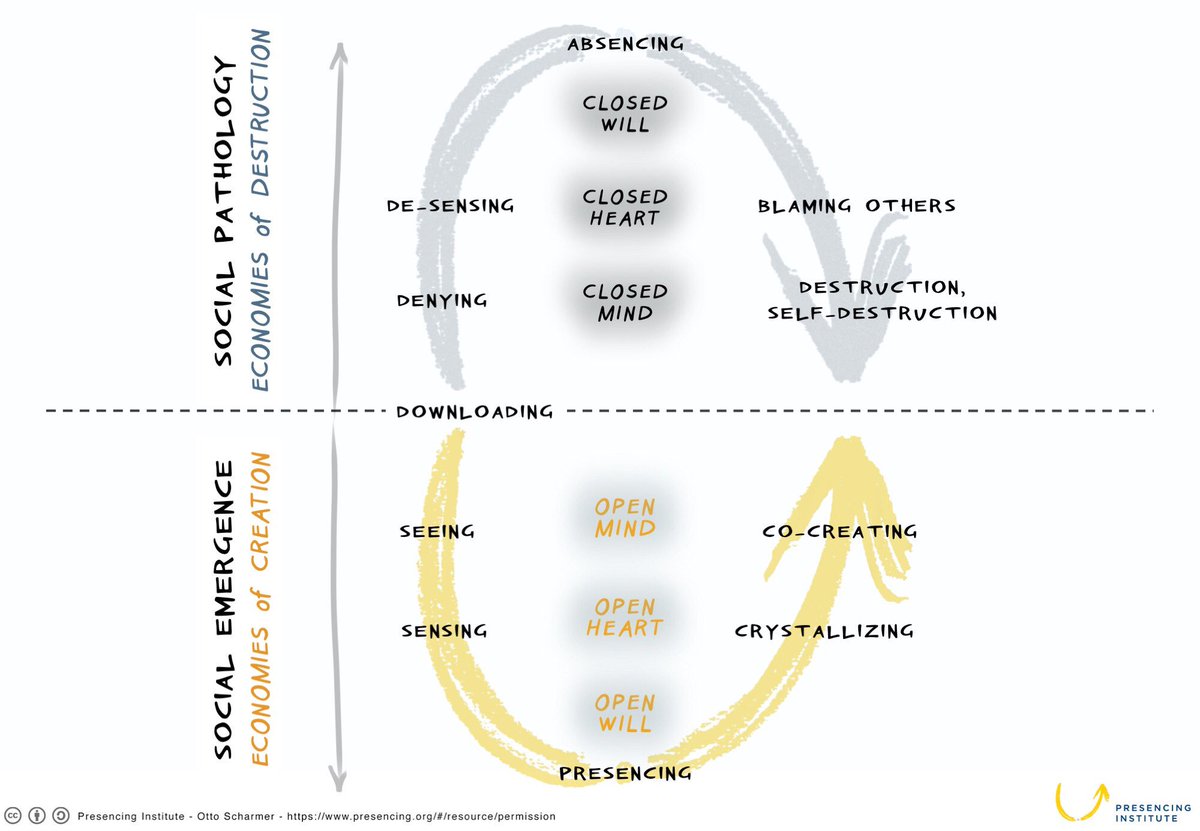
Here we will use Theory U framework as a lens, helping us to illuminate some underlying patterns of the movement.
A Framework for Conscious and Systemic Change
Otto Scharmer, a researcher at MIT, spent years studying how individuals, organizations, and social movements transform—or fail to. He developed Theory U: a map of the inner conditions from which change happens. His central insight is disarmingly simple: The quality of results we create depends on the inner state from which we are acting.
Most of the time, we operate in what Scharmer calls “Downloading” state. We simply repeat the old stories, the old grievances, and the old ways of seeing. It’s like playing a scratched record and expecting a new song to come out. To break this cycle, a movement must choose between two directions:
A. Presencing: Moving Toward the Future Possibility
A movement that is “presencing” can observe its own behavior honestly. It can sit with complexity without rushing to simplify it. It can feel anger and grief without turning them into hatred. It moves from Debate (where the goal is to win and prove others wrong) to Dialogue (where the goal is to see the whole truth and understand what the system as a whole needs).
In simple terms, it means pausing long enough to stop reacting, and beginning to respond from a deeper place; a shared-sense of future possibility.
B. Absencing: Repeating the Past Patterns
This is a closing down of awareness. The movement narrows. Certainty hardens. Emotional pain converts into hostility. Action accelerates while reflection disappears. In this state, a movement can become very energetic and very dangerous at the same time—to its enemies, and eventually to itself.
You can recognize this state in a conversation where no one is really listening—only waiting for their turn to attack.
From Absencing to Presencing: Three Capacities that Make the Difference
To move down the “U” and away from reactive patterns, we need three specific forms of openness:
- Open Mind: The ability to genuinely question what you believe. Not performing humility, but actually being willing to discover you were not seeing the whole picture. It asks: What am I not seeing?
- Open Heart: The ability to stay in contact with your feeling without being controlled by it. It means allowing grief to be grief and anger to be anger—without those feelings collapsing into the dehumanization of the “other.”
- Open Will: The willingness to let go of the need to control and prevail-over the “other.” It asks: What kind of society is actually trying to be born here, and how do we help it?
Where these three are present, regenerative dialogue becomes possible. Where they are absent, we are simply downloading our old traumas into new political containers and social movements.
Patterns in the Iranian Diaspora
These patterns are not unique to Iranians—they appear in many movements shaped by pain—but they are visible here in specific ways. Parts of the Iranian diaspora movement carry a genuine democratic aspiration. And yet, when you observe how the movement actually operates, certain patterns of “Absencing” become visible.
Certainty that Shuts Down Thinking One pattern is the reduction of a complex situation into moral absolutes. The Islamic Republic is brutal—this is an objective fact. But from there, some voices move quickly to: anyone who questions our tactics is a sympathizer; any hesitation is betrayal. This is a Closed Mind.
For example, when questioning a tactic or a leader’s capacity immediately labels someone as disloyal, thinking has already stopped. And a movement that cannot think cannot learn and grow.
Anger that Curdles into Hatred The anger in the diaspora is earned. But there is a difference between anger that fuels and anger that corrupts. When voices in the movement call for the bombing of Iran—knowing this means killing the very civilians they claim to liberate—something essential has crossed a line.
An Open Heart does not suppress anger; it holds it without losing its humanity, without becoming a slave of hatred.
Action without Accountability Advocating for drastic measures while living far from the “blast radius” carries a specific moral weight. A mature democratic culture must be able to name this distance honestly. Democracy requires that those who call for action remain morally connected to its consequences—even when those consequences are distant.
The Pattern History Keeps Showing Us
Iran has its own painful experience of this dynamic. The 1979 Revolution brought together a beautiful, diverse coalition. They succeeded in overthrowing the previous system, but they had not built the “inner architecture” of listening and trust. One faction, operating with the most certainty and the least tolerance for dissent, consolidated power and dismantled the rest.
The lesson is vital: The inner structure of a movement matters as much as its external goals. Changing a government without changing our patterns of listening and relating is like replacing a manager in a dysfunctional office. The name on the door changes, but the culture of fear, favoritism, and silencing remains the same.
What a More Conscious Movement Looks Like
Real transformation is not just a political event; it is a systemic shift that happens at three scales simultaneously:
- Individual: People becoming aware of their own triggers and choosing to respond rather than react.
- Small Groups: Learning the “muscle” of dialogue and cooperation across differences.
- Institutions: Building structures that reflect that trust and accountability.
In other words, change has to happen in people, in relationships, and in structures—all at once. A nation or a society is not a machine, but a whole living being. It cannot be repaired by replacing a single part like the government. It evolves through the quality of relationships between its parts—through trust, awareness, and shared meaning.
For example, a conscious movement treats disagreement as information, not betrayal. It stops seeing the current government as a foreign body, a cancer to be removed, and begins to ask: What in our culture and history made this dynamic possible?
Reaching Toward the Depth
The reactive question is: How do we get rid of what we hate? The generative question is: What kind of Iran is trying to be born?
Iran has a tradition of poetry and philosophy that has grappled with justice for millennia. A movement that draws on Rumi, Hafez and Ferdowsi, on Ishraq wisdom, or even the constitutional revolutionaries of 1906 is not just fighting against something. It is reaching toward something. It draws on “The River Beneath the Noise“—the deep cultural current of patience, presence, and wisdom; the soul of the land. A true regenerative movement is impossible without listening to the river below.
Democracy as a State of Being
Democracy is not something we install after winning; it is something we embody now. It lives in how we listen, how we argue, and whether we are honest enough to examine ourselves. It depends on whether we are willing to shift our attention from reacting to a government toward sensing a future possibility. Without this inner work, democracy becomes a mere technique on the surface. With it, it becomes a way of being.
The Iranian people deserve a movement that is as serious about its inner state as it is about its political goals. This is not because inner work is a luxury, but because without it, political action tends to circle back to the same place. Otherwise, we risk rebuilding the same town hall—different faces, same shouting.
That examination of the inner state is not a weakness. In the Iranian context, after everything that has happened, it may be the most courageous act of all.

